
Parks and Public Grounds
Parks, civic grounds and public open space, and the entry strips, islands and verges around them. These are the areas that consume irrigation and mowing budget all year and still look patchy at the end of a dry season.

Artificial turf for commercial and HOA properties: courtyards, amenity decks, medians, pet relief areas and common-area landscape that has to look maintained without being mown.
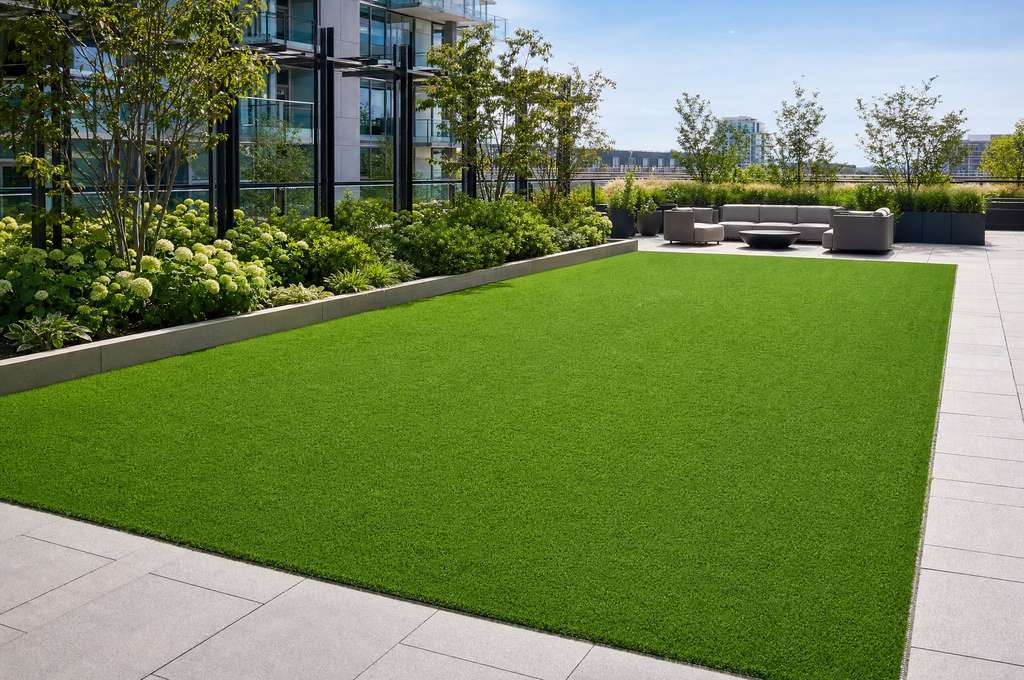
Commercial artificial turf installation replaces the part of a landscape that costs the most to keep alive and looks the worst when it is not. We install synthetic turf on commercial and association properties across Tampa Bay: courtyards and amenity decks, entry and median landscape, pet relief areas, and the common-area strips irrigation never quite reaches.
Parks, civic grounds and public open space, and the entry strips, islands and verges around them. These are the areas that consume irrigation and mowing budget all year and still look patchy at the end of a dry season.
Courtyards, amenity decks, rooftop terraces and shared outdoor space, including areas with no planting depth where turf is the only way to get a green surface at all.

Pet relief areas and dog runs, where the drainage build-up and the infill specification matter more than the turf itself, because that is what decides whether the area develops an odor problem.

General play and childcare surfacing outside equipment fall zones. Impact-attenuating surfacing under playground equipment is a rated specification of its own. Ask us about your site instead of assuming it is included.

The grounds of a sports complex rather than the field itself: spectator banks, walkways, entries, surrounds and the landscape between them, where turf removes an irrigation and mowing line from a site that is in use every weekend. Playing surfaces are a separate specification with their own standards and testing, and they are not what this covers. Tell us what the area is used for and we will say plainly whether it is work we will take on.

The case for synthetic turf on a commercial site is rarely aesthetic. It is that one area is expensive to keep green and keeps failing anyway: a shaded courtyard where nothing establishes, a median that irrigation cannot reach without watering the road, a dog run gone to dirt, or an amenity deck with no soil to plant into. Those areas absorb water, mowing, fertiliser and replanting every year and still look tired.
For a board or a property manager, that makes it a budget comparison and not a taste question: one installed cost against an irrigation, mowing and replanting line that recurs indefinitely. It is also why turf gets specified for defined problem areas instead of a whole property.
It is driven by the area, what is under it now, and how much base work the ground needs. An amenity deck with no soil and a worn dog run over compacted clay are different jobs at the same square footage. We price after walking the site, because a number given without seeing the ground is a guess that gets corrected upward later. Call 727-245-0123 to arrange a walkthrough.
Drainage is the whole job here. A synthetic surface installed over a base that does not drain becomes a shallow pond in a Gulf coast summer, and on a pet area it becomes a smell problem within weeks. The base build-up under the turf matters considerably more than which turf goes on top of it, and it is where a cheap installation is usually cheap.
Two other things are worth knowing before you specify it. Synthetic turf in direct, unshaded sun gets significantly hotter underfoot than natural grass, which matters for a pet area or anywhere people sit down. Shade, aspect and how the area is used should be part of the conversation. And infill choice is not a detail on pet areas, where a drainage and odor-control specification is the difference between a surface that works and one the residents complain about.
It drains as well as the base underneath it, which is why the base build-up is the part of the specification that matters most here. Ground that does not drain holds water under the turf, and on a pet area that turns into an odor problem quickly. It is the first thing we look at on a site walk.
It is one of the most common commercial uses for it, because the alternative on a well-used pet area is usually dirt. What makes it work is the drainage build-up and an infill chosen for odor control rather than a general-purpose one. Worth knowing as well: turf in full unshaded sun gets hotter underfoot than grass, so shade matters on an area animals use in the afternoon.
Ten to fifteen years is the commonly quoted range for quality commercial turf, and the spread is about use rather than time. Fibers in full Florida sun age faster than shaded ones, and a dog run or a busy desire line wears years before a decorative median does. What usually ends an installation is not the fiber wearing out but the base failing underneath it or the infill compacting, which is why the parts you cannot see decide the lifespan more than the product brochure does.
Our work here is commercial and association landscape turf: courtyards, common areas, medians and entry planting, amenity decks, and pet relief areas. That is the scope this page describes.
Some things are better answered about your specific site than asserted on a web page. The base and drainage build-up your ground actually needs, what the turf and the installation are each warranted for, and whether a particular area is suitable at all. Athletic fields, putting greens, and playground surfacing under equipment are separate specifications with their own standards, and rather than claim them here we would rather you ask. Call 727-245-0123 and we will tell you plainly what we will and will not take on.
Those are separate specifications with their own standards, and the same is true of impact-attenuating surfacing under playground equipment. Rather than claim them on a web page, tell us what the area is and how it will be used on 727-245-0123 and we will tell you plainly whether it is work we will take on.
The trade uses several names for the same work, and all of them describe what this page covers. What changes a quote is the building, never the phrase.